
The Podium Formula One Needed
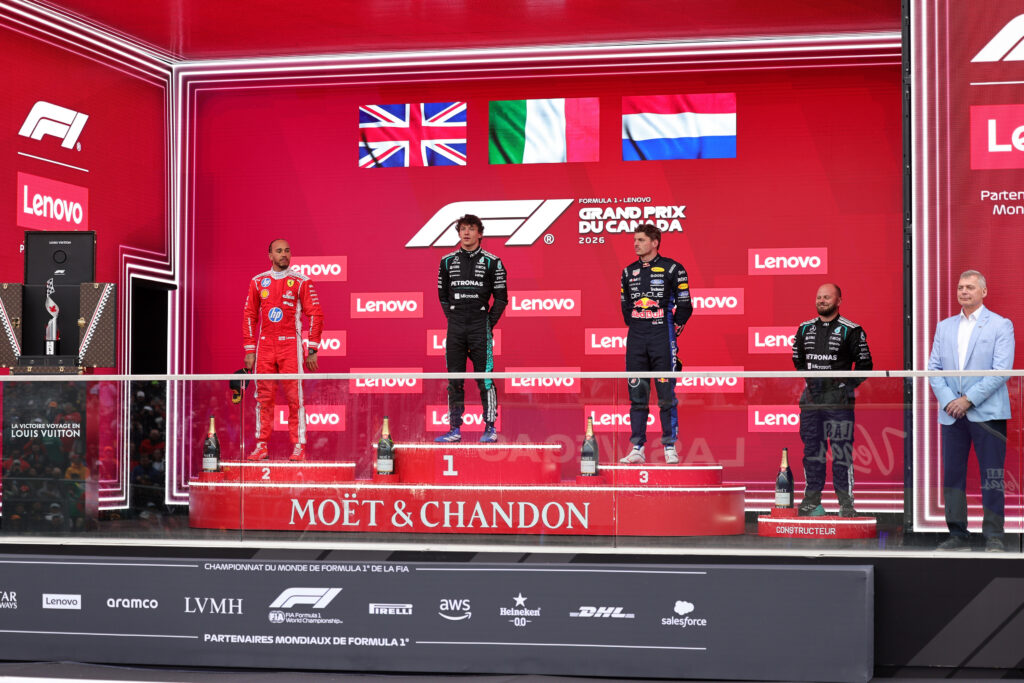
Kimi Antonelli arrived in Montreal as one of Formula One’s most talked-about young stars. He left Canada looking like something far more dangerous for the rest of the grid: a driver fully capable of leading a championship-caliber team under pressure.
The Canadian Grand Prix weekend at Circuit Gilles Villeneuve began with uncertainty and frustration for Mercedes, but it ended with Antonelli delivering the biggest victory of his young Formula One career in a race that demanded composure more than outright speed.
What initially looked like another strong weekend for George Russell quickly evolved into Antonelli’s defining moment.
Mercedes entered the weekend with pace immediately. Russell captured the Sprint victory earlier in the weekend after an aggressive battle with Antonelli, though the younger Mercedes driver left the Sprint frustrated after being forced wide during their fight for position. The tension between the two Mercedes drivers never felt hostile, but it did establish an important theme heading into Sunday: Mercedes finally had two drivers capable of fighting at the front.
Sunday’s Grand Prix began under threatening skies with rain surrounding the circuit before lights out. The uncertainty forced race control into two formation laps before the field officially settled into a reduced 68-lap race distance.
The pre-race chaos continued immediately when Arvid Lindblad’s No. 41 Racing Bulls machine suffered a clutch issue before the start, forcing marshals to push the car away during the formation procedure. It was an embarrassing beginning for the Red Bull junior operation and an early reminder that Montreal rarely delivers a calm afternoon.
Once the race finally went green, the opening laps reflected the nervous atmosphere surrounding the circuit.
Lando Norris launched aggressively through the opening corners while Pierre Gasly locked up heavily at Turn 5 on Lap 1 as drivers struggled to fully trust the grip level after the extended formation sequence. The early laps produced rapid position changes across the field, though the timing screens often struggled to fully capture the chaos unfolding through the midfield.
Despite the early aggression from McLaren, Mercedes quickly established control.
Russell and Antonelli both showed exceptional pace through the opening stint while Max Verstappen quietly remained within striking distance for Red Bull. Lewis Hamilton also stayed firmly inside the fight near the front, while Ferrari appeared solid but lacked the outright pace necessary to immediately challenge for the lead.
The race initially looked destined to become a comfortable Mercedes afternoon.
Then everything changed.
Around the midpoint of the race, Russell crashed out in one of the defining moments of the Grand Prix. The retirement immediately transformed the emotional center of the race. Mercedes went from controlling the event with both cars to relying entirely on Antonelli to survive relentless pressure from Verstappen behind him.
For many young drivers, that situation becomes the moment where mistakes begin.
Instead, Antonelli looked calmer with every passing lap.
The young Mercedes driver steadily built the gap over Verstappen while managing traffic, tire degradation, and the constant pressure that comes with leading at Circuit Gilles Villeneuve. Canada has historically punished even world champions with small mistakes, particularly late in races as tire wear increases and concentration fades. Antonelli never cracked.
If anything, he became faster.
While Verstappen attempted to remain close enough to capitalize on any Mercedes error, Antonelli slowly turned the race from a tense battle into a controlled masterclass. Hamilton eventually climbed into second place as Mercedes salvaged a remarkable result despite Russell’s earlier retirement, while Verstappen faded to third in the closing stages.
Further down the order, Isack Hadjar quietly produced one of the strongest drives of the weekend with a fifth-place finish, while Franco Colapinto, Liam Lawson, Pierre Gasly, Carlos Sainz Jr., and Oliver Bearman rounded out the points-paying positions.
McLaren’s afternoon collapsed after its promising start. Norris eventually retired after early-race issues compromised the team’s strategy and pace, while Oscar Piastri spent much of the race trapped deep in the midfield following a disastrous opening phase.
The race itself never fully became the wet-weather chaos many expected before lights out. Instead, the Canadian Grand Prix evolved into something more revealing: a race centered around discipline, tire management, and mental composure.
That is exactly why Antonelli’s victory matters so much.
This was not a lucky win created by weather strategy or a late safety car. Antonelli led 43 laps and controlled the race’s most critical moments against Verstappen while carrying the pressure of being Mercedes’ lone surviving contender.
His final statement came at the very end. After already securing victory, Antonelli delivered the race’s fastest lap with a 1:14.210, a message to the rest of the paddock that he was not simply surviving under pressure. He was the quickest driver on the circuit.
In a sport that constantly searches for its next superstar, Canada may ultimately be remembered as the weekend where Antonelli stopped looking like the future of Formula One and started looking like its present.