
Chaos, Control, Antonelli
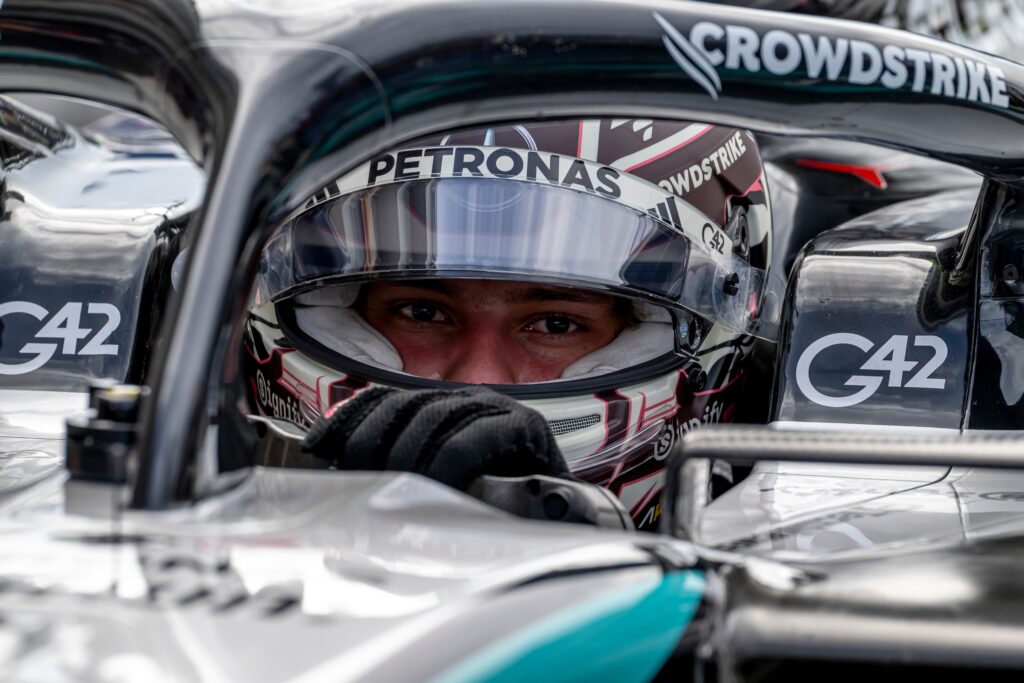
The Only Constant in Miami Was Antonelli’s P1
The Miami Grand Prix never found rhythm.
From the opening laps through the final corner, this was a race defined by disruption—incidents, shifting strategies, uncertain weather, and a front of the field that refused to stay the same for more than a few laps at a time.
And yet, through all of it, one thing kept returning.
Kimi Antonelli at the front.
Chaos From the Opening Laps
The race unraveled almost immediately.
Within the opening phase, two separate incidents unfolded nearly at the same time in different parts of the circuit, forcing an early reset and wiping out any chance of a clean opening stint. The field compressed, strategies were abandoned before they could even develop, and the tone for the afternoon was set.
This wasn’t going to be a race about control.
It was going to be about reaction.
One of the most telling moments came from Isack Hadjar, who, after his early exit, remained in the car for nearly a minute—visibly frustrated, striking his helmet against the halo and steering wheel before climbing out. It was a raw reaction that reflected just how unforgiving the opening laps had been.
A Race Without Control
As the race developed, no driver was able to take lasting command.
By the midpoint, there had already been five different leaders. The front changed hands repeatedly, not through dominance, but through timing—pit cycles, positioning, and strategy calls made under uncertain conditions.
Nothing stuck.
- Early incidents reshuffled the order
- The safety car reset momentum
- Tire strategies split between mediums and hards
- Light rain introduced uncertainty without ever fully committing to the track
At times, the circuit appeared dry. At others, teams were reacting to forecasts more than conditions.
This wasn’t traditional strategy.
It was interpretation under pressure.
Pressure Builds at the Front
Out of that chaos, a clearer fight began to form.
Antonelli and Lando Norris emerged as the central battle, with Norris applying steady pressure through the race’s second half. But while Norris remained composed, Antonelli’s race began to show signs of strain.
The radio told the story.
First came concerns about a gearbox issue, referencing a paddle. The response from the pit wall was calm—no issue. Soon after, Antonelli reported that his rear tires were “gone.”
Again, the response corrected it.
Not degradation. Temperature.
Nothing was fundamentally wrong. But everything felt urgent.
That’s what pressure looks like when you’re leading a race like this.
Strategy Splits the Field
Behind them, the race continued to divide.
Max Verstappen, after pitting earlier than many of his rivals, found himself on a different strategy—running the hard compound but gradually losing the ability to stay in the fight. What began as an aggressive call became a defensive one.
Charles Leclerc capitalized.
Late in the race, he moved past Verstappen for third in a clean, controlled overtake. Neither driver forced the issue beyond what the moment required, a rare moment of restraint in a race filled with pressure.
Further back, George Russell and Oscar Piastri delivered one of the most compelling battles of the race, trading positions over multiple laps in a fight defined by precision and persistence.
Weather That Never Fully Arrived
Throughout the race, the weather remained a constant question.
Light rain came and went, never fully impacting the track visually, but consistently influencing decisions. Teams were given windows—four to five laps, then later ten to fifteen—but the conditions never fully materialized.
It was enough to force decisions.
Not enough to confirm them.
Pit stops came at different times. Tire choices varied. Some committed early. Others waited. Many reacted.
By the final stint, the rain threat began to fade, and for the first time all race, the order started to stabilize.
The Final Laps
With fewer than ten laps remaining, the race finally simplified.
Antonelli led.
Norris followed, just over a second behind.
Leclerc held third, comfortably clear of the fight behind.
After everything that had come before, it came down to execution.
Antonelli, who had spent much of the race reacting, now had to manage.
Norris, who had remained patient, needed a mistake.
But it never came.
One Last Twist
Even in the closing moments, Miami nearly delivered one final shock.
On the final lap, Charles Leclerc spun, coming dangerously close to turning a strong race into a complete disaster. He managed to keep the car out of the wall, but only just.
It was a moment that summed up the race perfectly.
Unpredictable. Unforgiving. Always on the edge.
The Only Constant
In a race where five different drivers led, where strategy split the field, and where conditions never fully settled, one thing remained.
Antonelli.
Not through dominance.
Through control.
This was his third victory—and another step in what is quickly becoming one of the most remarkable starts to a Formula 1 career in recent memory.
But this one mattered differently.
This wasn’t clean.
This wasn’t easy.
This was earned.
Because in a race where everything changed, the only constant was who handled it best.
Final Classification (Unofficial)
- Kimi Antonelli
- Lando Norris
- Oscar Piastri
- George Russell
- Max Verstappen
- Charles Leclerc
- Lewis Hamilton
- Franco Colapinto
- Carlos Sainz
- Alexander Albon